Screening · 5 min read
Background checks for volunteer firefighters: who runs them, who pays, and what your state requires
Ross Shaffer and the Firehouse Desk team · November 2026

The short version
There is no single national rule. Some states require a criminal history check for every applicant, some run it through the state police with fingerprints, and who pays differs from place to place. Decide which check you run, who pays for it, and where the result is kept. This is general information, not legal advice.
What states require
North Carolina is a clear example. Since a 2022 law, a criminal history record check is required for anyone who applies for a paid or volunteer position with a fire department, junior firefighters included.
Delaware runs a state and federal check through its State Bureau of Identification for people joining a volunteer fire company, and state law says membership must be denied after certain convictions.
Other states leave more to the department. The University of Tennessee’s municipal advisory service publishes a sample policy that treats firefighter as a position of public trust and makes membership conditional on passing a check.
Your state fire marshal’s office or county attorney can tell you which of these your department falls under.
Who pays
This varies as much as the checks do. North Carolina lets a department pass the state’s fee on to the applicant. The Tennessee sample policy has the applicant pay, and notes the city can choose to cover it. Delaware goes the other way: a volunteer fire company applicant cannot be charged for the state criminal history. Anne Arundel County in Maryland tells recruits that the drug test, physical and fingerprint check are provided at no cost.
Our view is simple. Asking someone to pay in order to volunteer is one more reason to walk away. If your department has to charge, say so on the first page of the application, not the last.
What a check costs
A name-based check from a large commercial screening company starts at about $30 a report, and court fees can be added on top. Fingerprint-based state and FBI checks carry fees set by the state. Budget for every applicant you expect in a year, not only the ones who join.
Three decisions to write down
Which check. Name-based, fingerprint-based, or both, and whether a driving record is included.
Who pays. The department, the applicant, or the county.
Where the result lives. Keep it with the application, limit who can open it, and decide how long you keep it.
A policy that answers those three questions will save your membership committee the same argument every time someone applies.
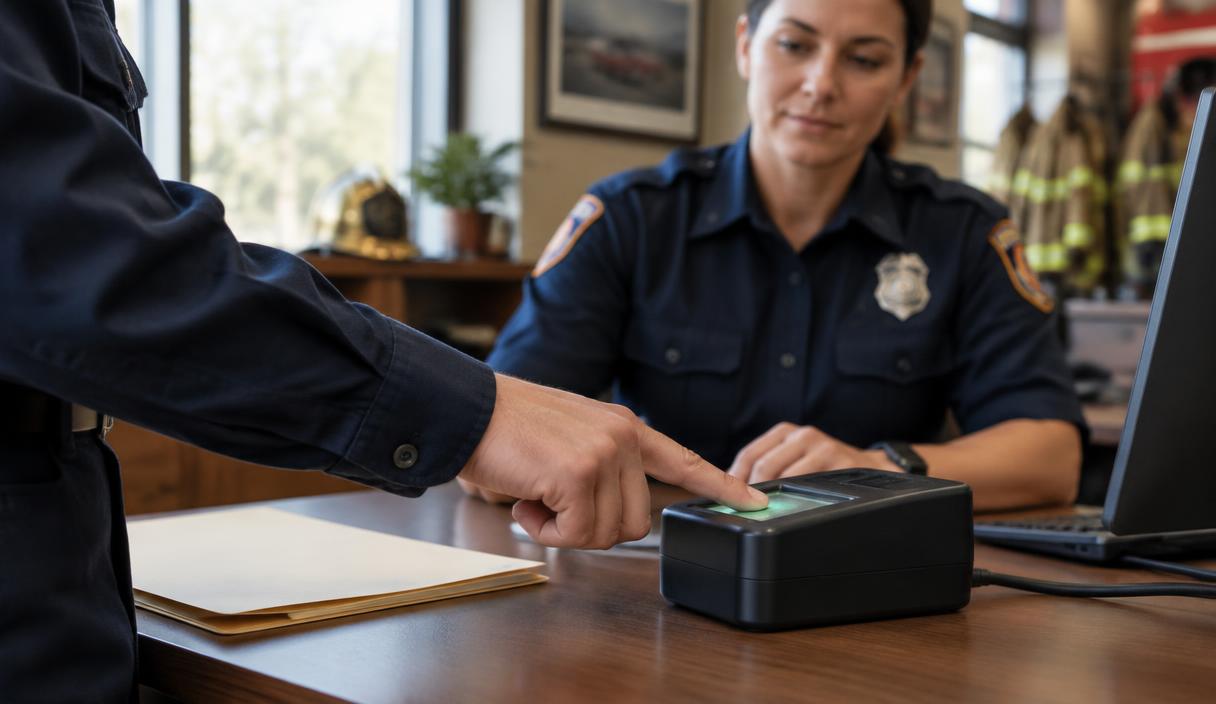
Tell applicants what to expect
A background check is the step where the most people quietly drop out, and it is rarely because they have something to hide. They were not told it was coming, they do not know how long it takes, and the silence feels like a verdict. Say on the application that a check is part of joining, who runs it, roughly how long it takes, and what happens next. Then tell them when it comes back.
If you use a commercial screening company, expect it to require a signed disclosure and authorization from each applicant before it runs anything. Ask the provider and your attorney which federal and state notice rules apply to volunteers in your state, and what you must do if a result leads you to turn someone down.
Juniors, and members already on the roster
Two questions catch departments out. North Carolina’s rule covers junior firefighters, and other states treat minors differently, so check before you assume. And a check at the door says nothing about a member who joined fifteen years ago. Ask your state office whether current members need one, and decide whether your department wants to repeat checks on a schedule.
What a check does and does not tell you
A criminal history check answers one question: does a record exist under this person’s identity in the places that were searched? It does not tell you whether someone will show up, take direction, or treat the public well. The interview, references and probation answer those. Treat the check as one step in the process and not as the decision.
The two common kinds work differently. A name-based check searches records using a name, date of birth and similar details, so it depends on that information being right and on which sources the provider covers. A fingerprint-based check ties the result to the person and is usually run through a state agency. Your state may require one or the other, so ask before you choose.
Decide in advance what disqualifies
The worst time to write the standard is with a result in your hand and a name attached to it. Write it first. Some states set part of it in law. North Carolina’s rule, for example, names arson and other felony convictions involving burning. Beyond what the law sets, the department should decide what it will weigh, how far back it looks, and who makes the call.
Then apply the same standard to everyone. The chief’s nephew and the stranger from two towns over get the same check and the same questions. Consistency is what protects the department when a decision is challenged.
Handle the result like the sensitive record it is
A background check result is among the most private documents a volunteer company will ever hold. Limit who sees it to the two or three officers who need to. Do not read it out at a meeting, forward it by email, or leave a printout in the office. Keep it with the application, in a place with restricted access, and decide how long you keep it after a decision is made.
A good rule: the membership votes on a recommendation, not on the contents of someone’s record.
When the result is not clean
Talk to the applicant before you decide. Records are sometimes wrong, and a common name can pull in someone else’s history. Give the person a chance to explain or correct it. If you used a screening company, there are notice steps to follow before and after you turn someone down, so ask the provider and your attorney what they are in your state. Write down what was decided and why, and keep that note with the application.
Quick answers
Do volunteer firefighters need a background check? It depends on the state. Some require one for every applicant, and others leave it to the department. Your state fire marshal’s office can tell you.
Can the department charge the applicant for it? In some states, yes. North Carolina allows the state’s fee to be passed on. Delaware does not allow a volunteer fire company applicant to be charged for the state criminal history.
How long does a check take? It varies with the kind of check and the state. Ask your provider for a typical range and put that range on the application, so applicants know what to expect.
Sources
More from The Size-Up